
The Sovereign AI Paradox: Why Energy Independence May Matter More Than Data Sovereignty
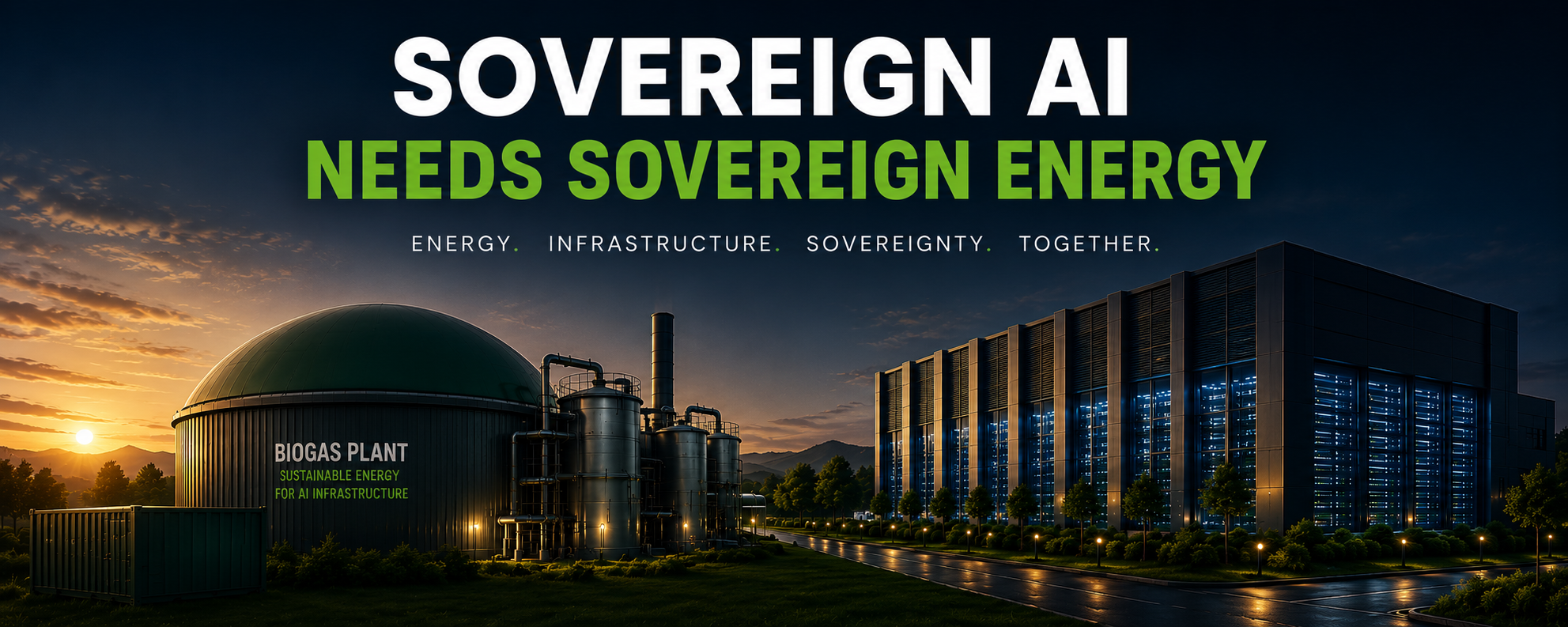
For the last two years, the AI industry has been obsessed with sovereignty. Sovereign AI. Sovereign clouds. Sovereign compute. National AI factories. Regional AI ecosystems. Across Europe and beyond, governments and enterprises are racing to ensure that AI infrastructure, data, and models remain under local control. The reasoning makes sense. AI is no longer just another technology platform. It is rapidly becoming part of economic strategy, national security, healthcare, manufacturing, research, and public services. Nobody wants to become completely dependent on a handful of hyperscalers or foreign infrastructure providers for technology that may eventually underpin critical parts of society.
However, while the industry focuses heavily on GPUs, data sovereignty, and regulation, another problem is quietly emerging underneath it all. That problem is power. Not software. Not models. Not even compute itself. Energy.
The uncomfortable reality is that you cannot build Sovereign AI without Sovereign Energy.
And for anyone who has seen me give a talk, presentation or event session, you’ll hear me talk about how Energy is a huge problem.
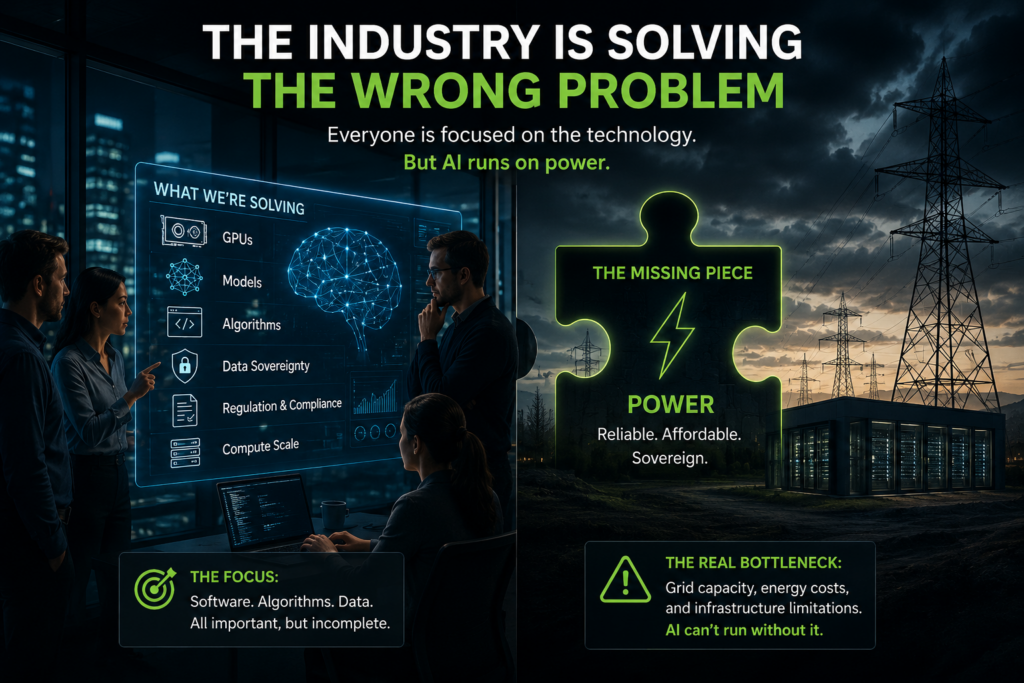
Most Sovereign AI discussions sound remarkably similar. They focus on keeping data local, running AI models inside national borders, reducing dependence on foreign cloud providers, and protecting intellectual property or sensitive information. These are all important goals, but very few organisations are asking the more difficult question: where is all the power going to come from?
AI workloads are changing the entire profile of modern infrastructure. Traditional enterprise workloads were relatively predictable from a power perspective. AI changes that completely. High-density GPU clusters consume enormous amounts of electricity continuously, not only for compute itself, but also for cooling, networking, storage, redundancy, and supporting infrastructure. A modern AI data centre no longer behaves like a traditional data centre. It behaves more like an industrial energy consumer.
That creates a challenge few countries are fully prepared for.
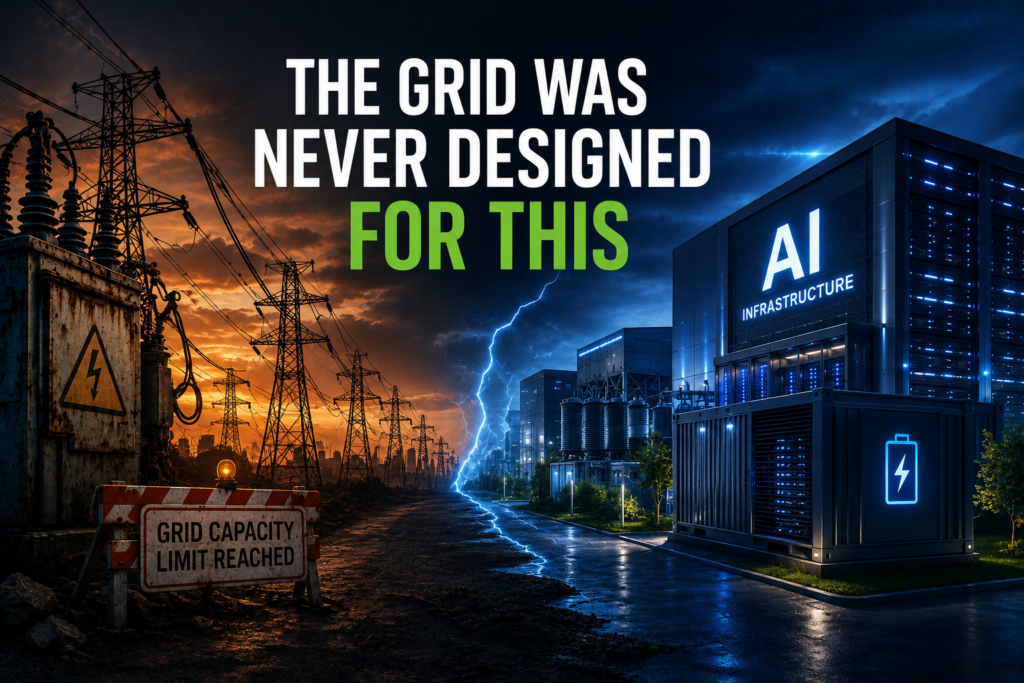
Much of Europe’s electrical infrastructure was designed decades ago, long before anyone imagined 100MW AI campuses, dense GPU superclusters, or always-on inference environments supporting millions of users. Today, many regions are already struggling with grid capacity constraints. Some AI and data centre projects are facing connection delays measured not in months, but in years. In some locations, organisations can secure land, investment, and hardware long before they can secure enough electricity to actually operate.
The challenge is no longer simply generating power. The challenge is delivering it where it is needed. Transmission infrastructure, substations, ageing grid architecture, and regional bottlenecks are all becoming major obstacles to AI growth. At the same time, energy costs continue to rise, placing additional pressure on organisations attempting to scale AI infrastructure sustainably.
This creates a dangerous contradiction for Sovereign AI ambitions. What happens when your infrastructure is sovereign, your data is sovereign, and your models are sovereign, but your electricity is not?
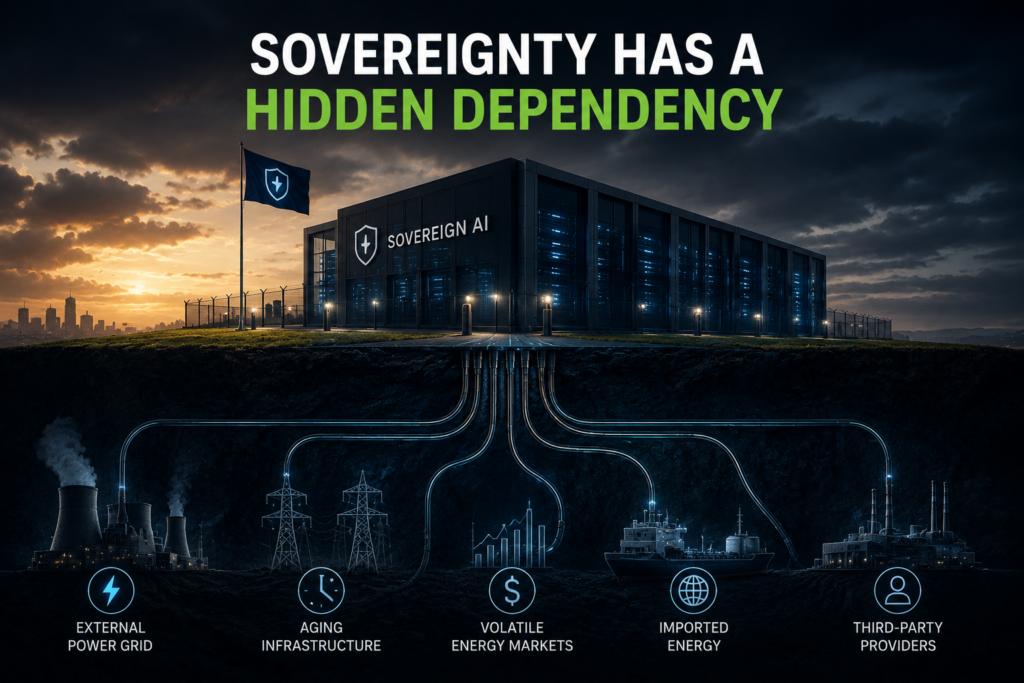
This is the part many organisations still overlook. Most Sovereign AI strategies still depend heavily on national grids, external utility providers, imported energy, congested transmission networks, and volatile energy markets. In other words, the infrastructure may be sovereign on paper, but operationally it still relies on external energy dependencies.
That dependency matters more than many people realise because AI does not gracefully degrade when power becomes constrained. When power availability becomes unstable or economically unsustainable, inference stops, training stops, operations stop, and revenue stops. As AI becomes increasingly integrated into critical services and commercial operations, energy resilience becomes just as important as cybersecurity or data protection.
This changes how we need to think about AI infrastructure entirely.

For many organisations, cloud has been the default answer for AI adoption, and for certain workloads it absolutely makes sense. However, when organisations begin talking seriously about Sovereign AI, the conversation becomes more complicated. Data residency concerns, compliance requirements, operational control, predictable costs, and long-term strategic independence are all pushing enterprises and governments toward more localised AI infrastructure models.
At the same time, hyperscalers themselves are facing growing power and capacity challenges as AI demand accelerates globally. The result is that organisations are beginning to rethink not just where AI runs, but how the underlying infrastructure itself is powered.
This is where the conversation becomes particularly interesting.
The next phase of AI infrastructure will not simply be about building larger data centres. It will be about smarter placement of compute and power together. Instead of asking “Where can we build AI infrastructure?”, organisations may increasingly need to ask “Where can we build sovereign energy and sovereign compute together?”
That shift changes everything because once energy generation and AI infrastructure become part of the same design strategy, organisations are no longer entirely trapped by grid expansion delays, transmission bottlenecks, multi-year connection queues, rising utility costs, or regional power instability.
This is where privately connected and energy-aware AI infrastructure models begin to make strategic sense. Not as a niche concept, but as a potential requirement for long-term AI scalability and sovereignty.
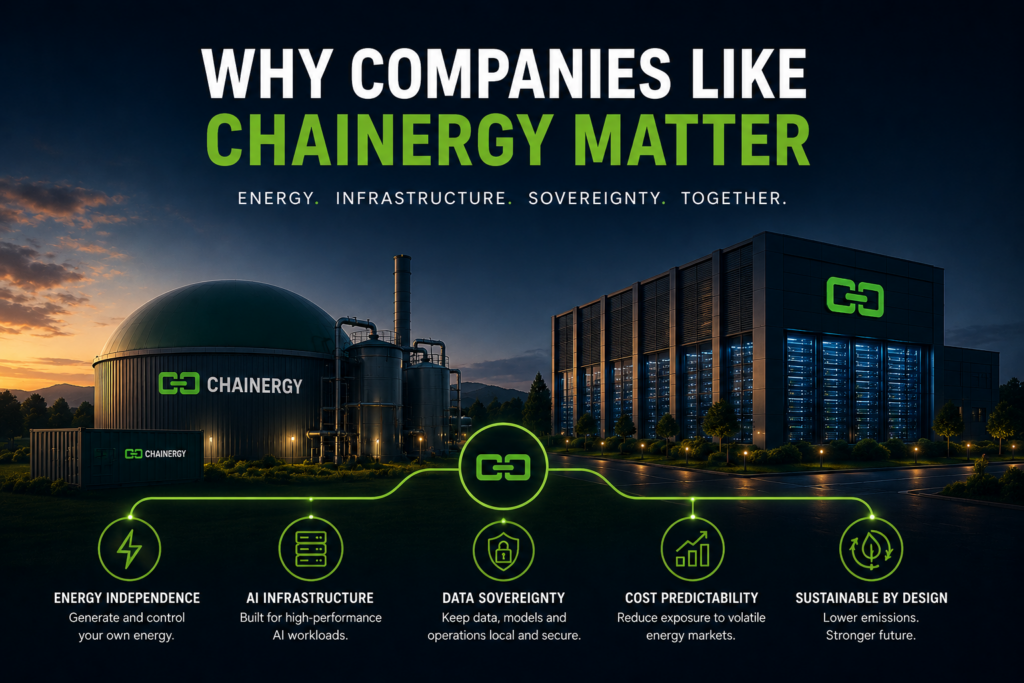
This is why companies like Chainergy are becoming increasingly relevant in the AI conversation. Not simply because of sustainability, and not simply because of cost reduction, but because they address a much larger strategic challenge.
The future of Sovereign AI may depend on organisations being able to combine local energy generation, energy resilience, AI infrastructure, data sovereignty, and operational independence into a single integrated platform. Instead of waiting years for grid upgrades or competing for already constrained power capacity, infrastructure can be designed around energy availability from the beginning.
That creates entirely new possibilities for regional AI deployments, edge AI infrastructure, private AI environments, industrial AI platforms, sovereign AI services, and AI-enabled critical infrastructure. In many ways, the industry is slowly discovering that the future of AI is no longer just a software challenge. It is an infrastructure challenge, and increasingly, it is an energy challenge.
The Next AI Race Will Be About Power
The first generation of AI competition focused on models. The second focused on GPUs. The third may focus on energy because the countries and organisations capable of securing reliable, scalable, affordable power for AI workloads will ultimately gain a major strategic advantage over those that cannot.
Sovereign AI is not just about where your data lives. It is about whether your infrastructure can continue operating independently, predictably, and sustainably at scale. The future of Sovereign AI may ultimately belong not only to those who control the compute, but to those who control the power behind it.