
The Great Data Centre Water Myth: A Reality Check on Liquid Cooling and Water Consumption
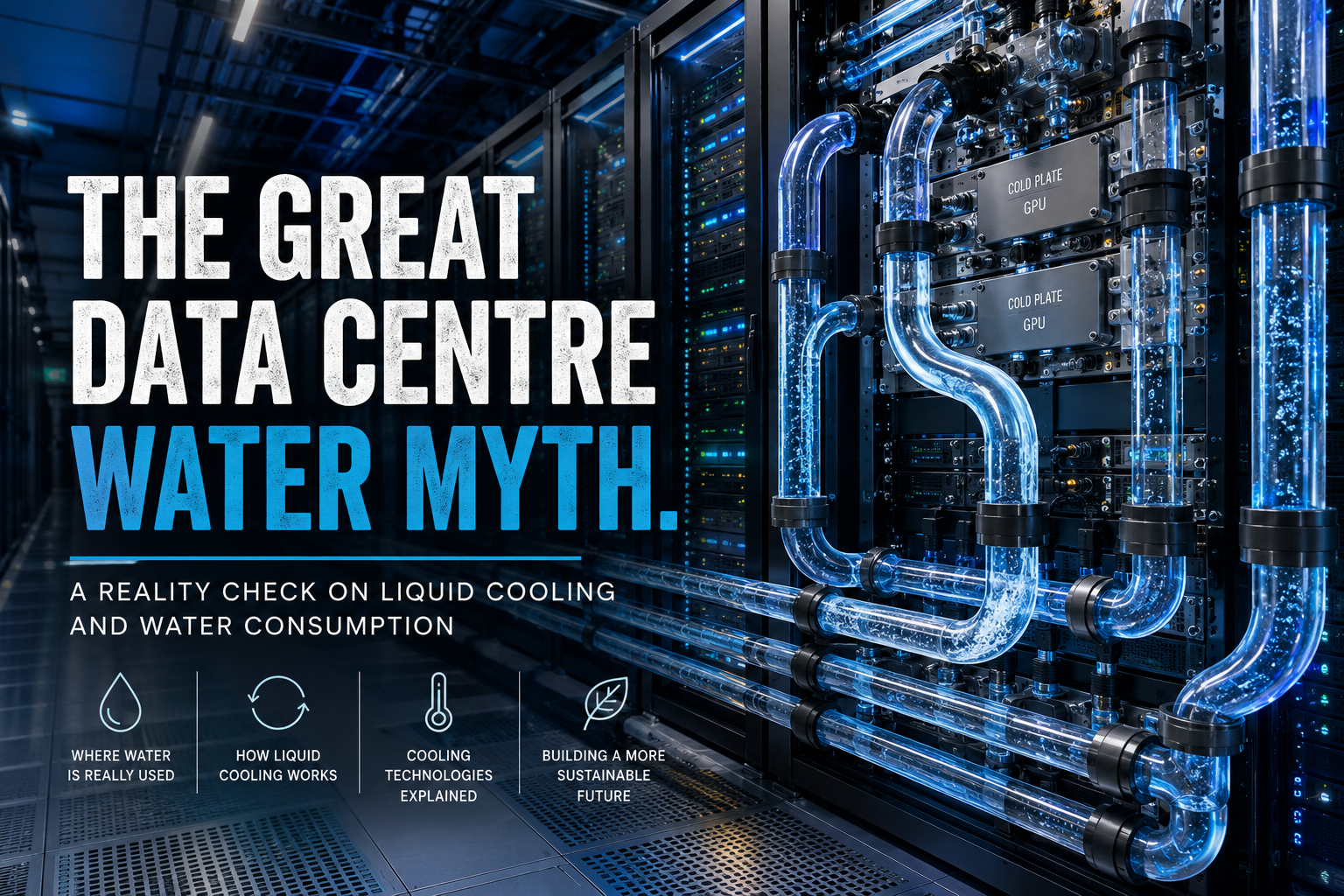
Understanding where water is actually used in modern data centres and where it isn’t.
Introduction
Over the past year, stories about data centres consuming vast quantities of water have become increasingly common. Headlines often suggest that modern liquid-cooled servers are continuously drawing fresh water from local supplies, while social media has amplified claims that newly constructed data centres are responsible for everything from reduced water pressure to local water shortages.
One widely shared video recently featured a homeowner claiming that the construction of a nearby data centre had left her house with noticeably lower water pressure. It is an emotive story, and one that naturally raises concerns about the impact these facilities have on the communities around them.
It is easy to understand why these concerns exist. If thousands of servers are described as being “water cooled”, it is perfectly reasonable to assume that they must be constantly consuming water in much the same way as a domestic appliance or industrial process.
Unfortunately, that assumption is based on a misunderstanding of how liquid cooling actually works. The reality is considerably different.
Modern liquid-cooled servers do not continuously consume water. Instead, they operate using sealed, closed-loop cooling systems in which the same coolant circulates around processors, pumps and heat exchangers thousands of times every day. Rather than being consumed, that coolant remains within the system for years, only requiring occasional maintenance or replacement during scheduled servicing.
This distinction is important because many discussions surrounding data centre water usage fail to separate the cooling system inside the server from the cooling infrastructure used by the building itself. While some data centres do consume significant amounts of water, that water is rarely being consumed by the servers themselves.
Understanding where water is actually used is essential if we are to have an informed discussion about the environmental impact of modern data centres.
Liquid Cooling Doesn’t Mean Continuous Water Consumption
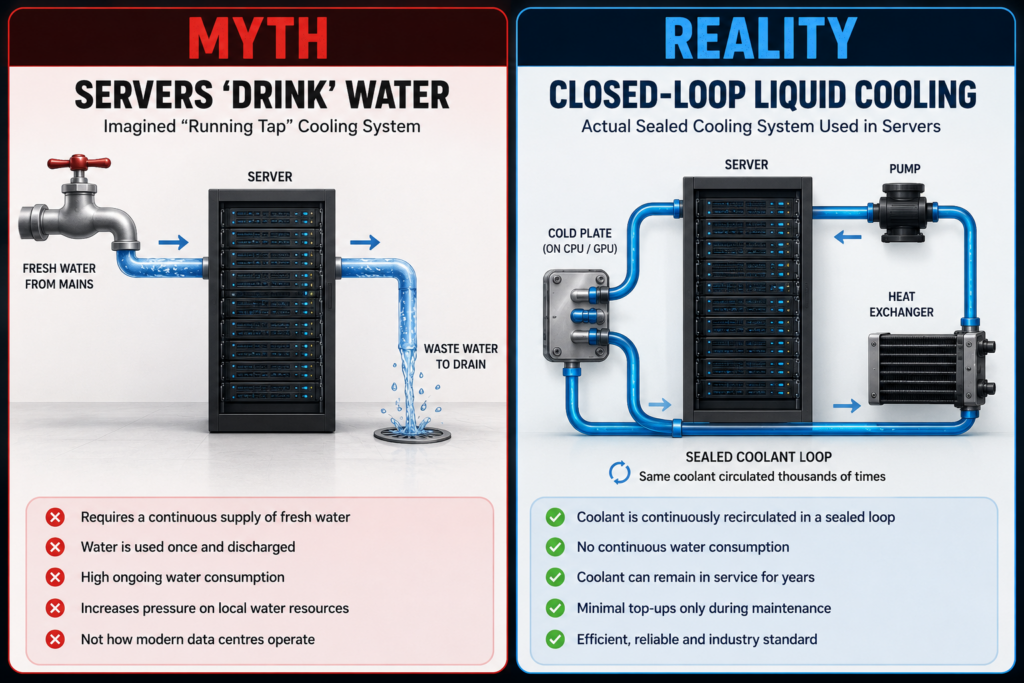
The phrase liquid cooling immediately conjures up an image of water flowing into a server, removing heat and then disappearing down a drain before being replaced by fresh water. It is an understandable assumption, but it bears little resemblance to reality.
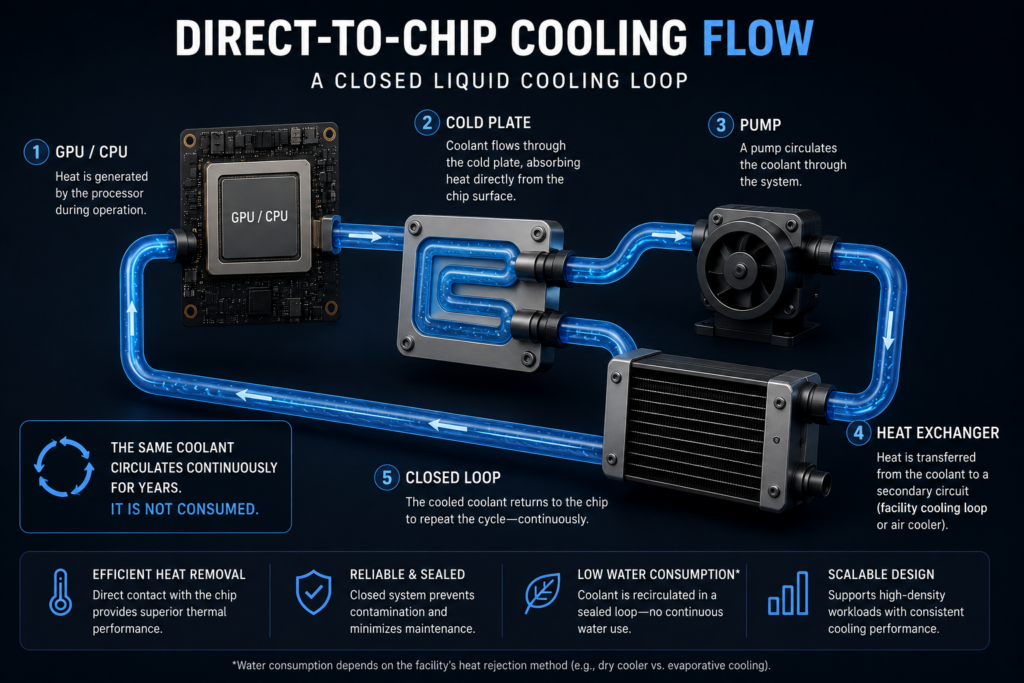
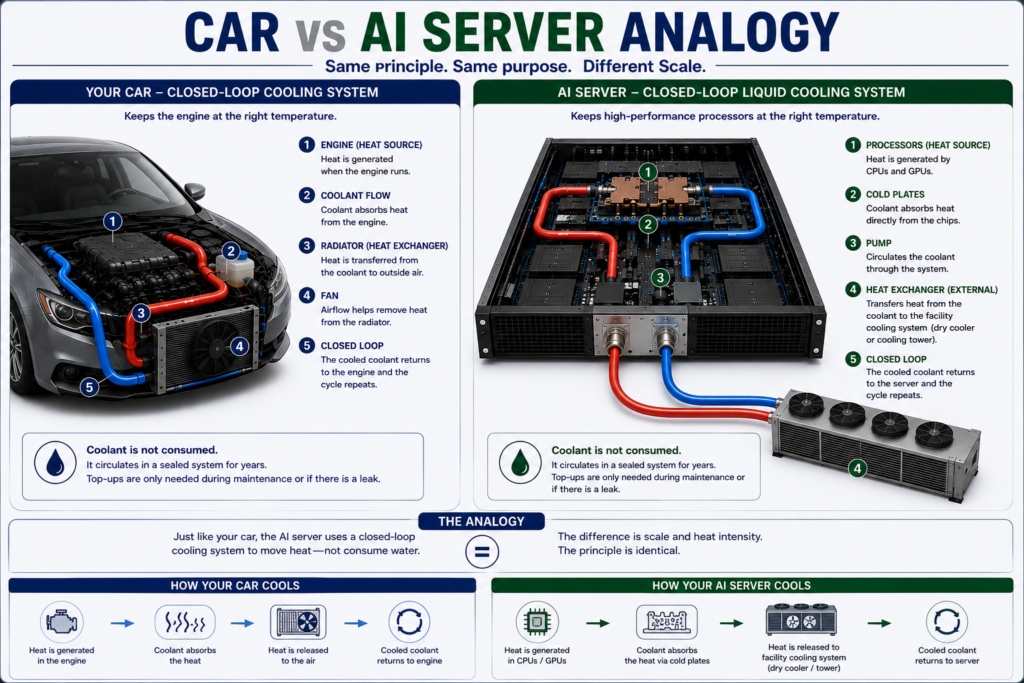
Modern Direct-to-Chip (DLC) cooling systems operate using a completely sealed hydraulic circuit. Inside each server, specially designed cold plates are mounted directly onto the CPUs and GPUs. A pump continuously circulates coolant through these cold plates, absorbing heat generated by the processors before transferring that heat to a heat exchanger. The cooled liquid then returns to the processors, where the cycle begins again.
Nothing leaves the system. The coolant isn’t poured away after one pass. It isn’t continuously topped up from the mains supply, nor is it discharged into the environment. Instead, it performs the same task repeatedly, circulating through the system thousands of times every day.
This is no different to countless other cooling systems used throughout industry. A family car doesn’t require a fresh tank of coolant every time you drive to work. Industrial machinery doesn’t replace its coolant every hour, and MRI scanners in hospitals don’t consume cooling liquid every time a patient is examined.
The coolant simply transfers heat. Exactly the same principle applies inside a liquid-cooled server.
Understanding Direct-to-Chip Cooling
As processor power continues to increase, traditional air cooling is becoming increasingly difficult to manage. Modern processors can dissipate several hundred watts of heat individually, while high-density accelerator servers may contain eight or more GPUs within a single chassis.
Rather than attempting to remove this heat using ever larger fans, Direct-to-Chip cooling transfers heat directly into a circulating liquid.
Each processor is fitted with a precision-engineered cold plate containing narrow internal channels. Coolant flows through these channels, absorbing heat directly from the silicon before being pumped towards a heat exchanger.
At the heat exchanger, the heat is transferred into a secondary cooling circuit before the now-cooled liquid returns to the server. The process is continuous. The same coolant circulates endlessly around the loop, maintaining stable processor temperatures whilst never being consumed.
Because liquid is significantly more efficient at transporting heat than air, Direct-to-Chip cooling also reduces the amount of airflow required within the server. This leads to lower fan speeds, improved thermal stability and significantly higher rack densities than would otherwise be possible.
Perhaps most importantly, the coolant itself remains inside a completely sealed system.
Where Does the Water Actually Go?
This is the point where many discussions become confused.
When reports state that a data centre consumes millions of litres of water each year, they are usually referring to the building’s method of rejecting heat to the outside world rather than the cooling system inside the servers.
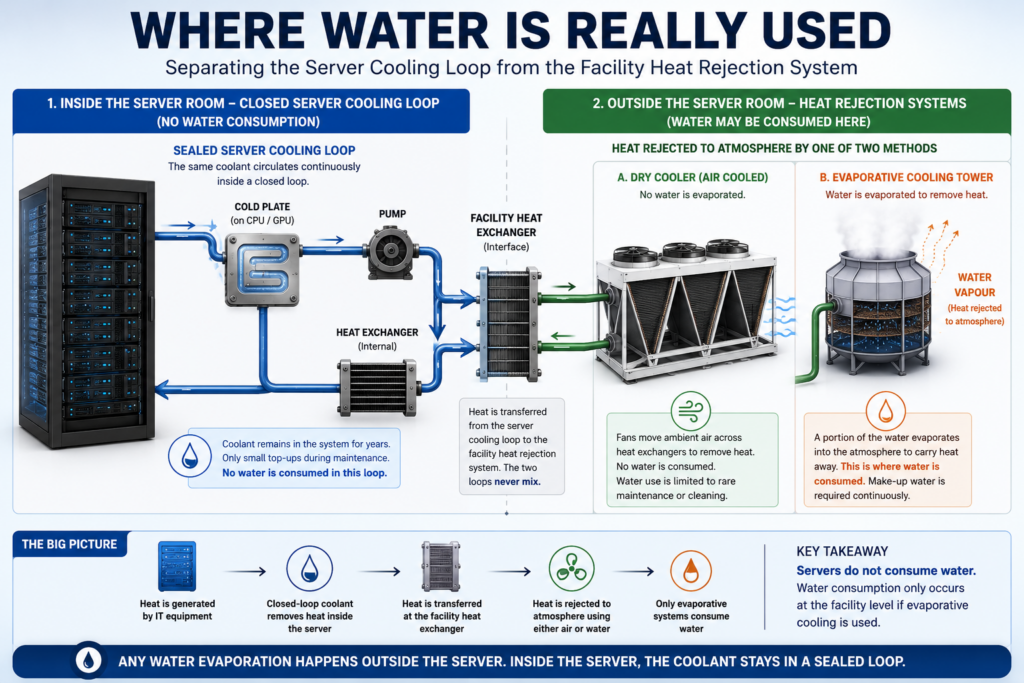
These are two completely separate systems. Inside the server is a closed coolant loop, outside the server is the facility cooling infrastructure. The two are connected only through a heat exchanger.
The server transfers heat into the facility cooling system, but the coolant circulating through the processors never mixes with the building’s cooling water. Once the heat reaches the facility cooling system, operators have several different options for rejecting that heat into the atmosphere.
Some facilities use large dry coolers that operate in much the same way as an oversized vehicle radiator. Fans draw ambient air across large heat exchangers, allowing heat to dissipate naturally without consuming water.
Other facilities employ evaporative cooling towers. These deliberately evaporate a portion of their cooling water because evaporation is an extremely effective method of removing large quantities of heat. This is where water consumption occurs. Not inside the server. Not inside the cold plates. Not inside the coolant loop. The distinction may seem subtle, but it fundamentally changes how we should think about liquid cooling.
Cooling Towers Are Not the Same as Liquid-Cooled Servers
Unfortunately, many articles unintentionally blur the distinction between server cooling and facility cooling. It is rather like claiming that every house with central heating continuously consumes radiator water. The radiators certainly contain water, but they don’t consume it. The water circulates around the heating system for years, transferring heat from the boiler before returning to repeat the process.
A liquid-cooled server behaves in exactly the same way. The building’s cooling tower, however, is an entirely separate piece of infrastructure. Its purpose is to reject heat from the building into the surrounding atmosphere. If the facility uses evaporative cooling, a proportion of the water evaporates as part of that process and must therefore be replaced.
The cooling tower consumes water. The server does not. Understanding this distinction removes much of the confusion surrounding modern data centre cooling.
Not Every Data Centre Uses Cooling Towers
Another common misconception is that every liquid-cooled data centre uses evaporative cooling. In reality, many facilities rely entirely on dry cooling technologies.
Large air-cooled heat exchangers, often referred to as dry coolers, use ambient air to remove heat without evaporating water. Although these systems may be slightly less efficient during extremely hot weather, they eliminate the ongoing water consumption associated with evaporative cooling towers.
Many newer facilities are also designed to operate with warmer cooling water, allowing them to reject heat directly to ambient air without requiring traditional refrigeration systems. As processor cooling technology continues to improve, the industry is increasingly moving towards solutions that reduce both energy consumption and water usage simultaneously.
Heat recovery systems are also becoming more common, enabling waste heat from servers to provide heating for offices, universities, residential developments and industrial buildings instead of simply being discharged into the atmosphere. Far from increasing water usage wherever possible, much of the industry is actively trying to minimise it.
The Car Analogy
Perhaps the simplest way of understanding closed-loop cooling is to compare it with the family car sitting on your driveway. Every internal combustion engine contains a cooling system consisting of a radiator, water pump, thermostat and coolant. The coolant continuously circulates around the engine, carrying heat away from the combustion chambers before transferring it to the radiator.
Nobody would describe a car as consuming coolant.
The coolant isn’t replaced every journey. It isn’t constantly being topped up from a hosepipe. It simply circulates around the engine for years, requiring only occasional replacement as part of routine maintenance. Modern liquid-cooled servers operate using exactly the same engineering principles.
The coolant is not a consumable. It is simply transporting heat.
Can Data Centres Still Affect Local Water Supplies?
The answer is yes.
Large industrial facilities of any kind increase demand on local infrastructure. Whether it is a manufacturing plant, a pharmaceutical facility, a hospital or a hyperscale data centre, careful planning is required to ensure that electricity, transport and water infrastructure can support additional demand.
Where concerns become entirely legitimate is when large evaporative cooling systems are installed in regions already experiencing water scarcity. In these cases, additional water demand may require investment in local infrastructure or careful long-term planning by water authorities.
However, this is a very different conversation from suggesting that liquid-cooled servers themselves are continuously consuming fresh drinking water. The distinction matters because one is a discussion about facility design and infrastructure planning, while the other is a misunderstanding of how modern server cooling actually works.
Engineering Reality Versus Public Perception
Like many engineering topics, the truth is more nuanced than the headlines often suggest. Yes, some data centres consume significant amounts of water. No, that water is not continually flowing through the servers themselves.
Modern liquid-cooled servers operate using sealed, recirculating cooling loops that retain the same coolant for years. The only time coolant is normally replaced is during scheduled maintenance, equipment upgrades or in the unlikely event of a leak.
Whether a facility consumes water depends almost entirely on how it rejects heat after it leaves the server. If dry coolers are used, water consumption can be extremely low. If evaporative cooling towers are employed, water consumption will be higher because evaporation forms part of the cooling process.
The server itself, however, remains unchanged. It continues to circulate the same coolant around a closed loop regardless of what happens outside the building.
Conclusion
The growth of high-performance computing has undoubtedly increased the need for more efficient cooling technologies, and liquid cooling has become one of the most effective ways of managing the enormous heat generated by today’s processors.
Unfortunately, the widespread use of the term water cooled has led many people to believe that these servers continuously consume fresh water.
They do not.
The coolant inside a modern liquid-cooled server is recirculated continuously within a sealed system, often remaining in service for years. Its purpose is simply to transport heat from the processors to a heat exchanger before repeating the cycle again.
Where water may be consumed is at the facility level, where engineers must ultimately reject that heat to the outside world. Some data centres achieve this using dry coolers with virtually no ongoing water consumption, while others use evaporative cooling towers that deliberately consume water as part of the cooling process.
These are two entirely different systems, yet they are often presented as though they are one and the same.
As with many engineering topics, understanding the detail changes the picture completely.
Rather than asking whether liquid-cooled servers consume huge amounts of water, the more meaningful question is:
How does the data centre reject its heat?
Because that is where the real discussion about water consumption begins not inside the server rack.