Autism, AI and the workplace: why different minds belong in the field

In September 2025, I was diagnosed with Autism Spectrum Disorder (ASD). I had already completed my Master’s degree. My dissertation looked at how artificial intelligence could support autism diagnosis and therapy, so autism and AI were part of my studies before I understood how closely the subject connected to my own life.
By the time I was diagnosed, I had already established a career in technology. For me, that is a reminder that ASD need not be a barrier to success. I continue to take on new work and learn as the field changes. I know my experience is only one person’s experience. Autistic people have different strengths, needs and ambitions. An ASD diagnosis should not be treated as a reason someone cannot succeed in technology or AI.
Autism in my working life
Today, I work in AI, architecting AI solutions. I also look at how AI may shape the future and explore innovative ways it could be used. One example I have written about is using cameras and edge AI on bin lorries to spot road deterioration as they follow their usual routes. The vehicles would carry on collecting waste while helping councils build a clearer picture of how local roads are changing.
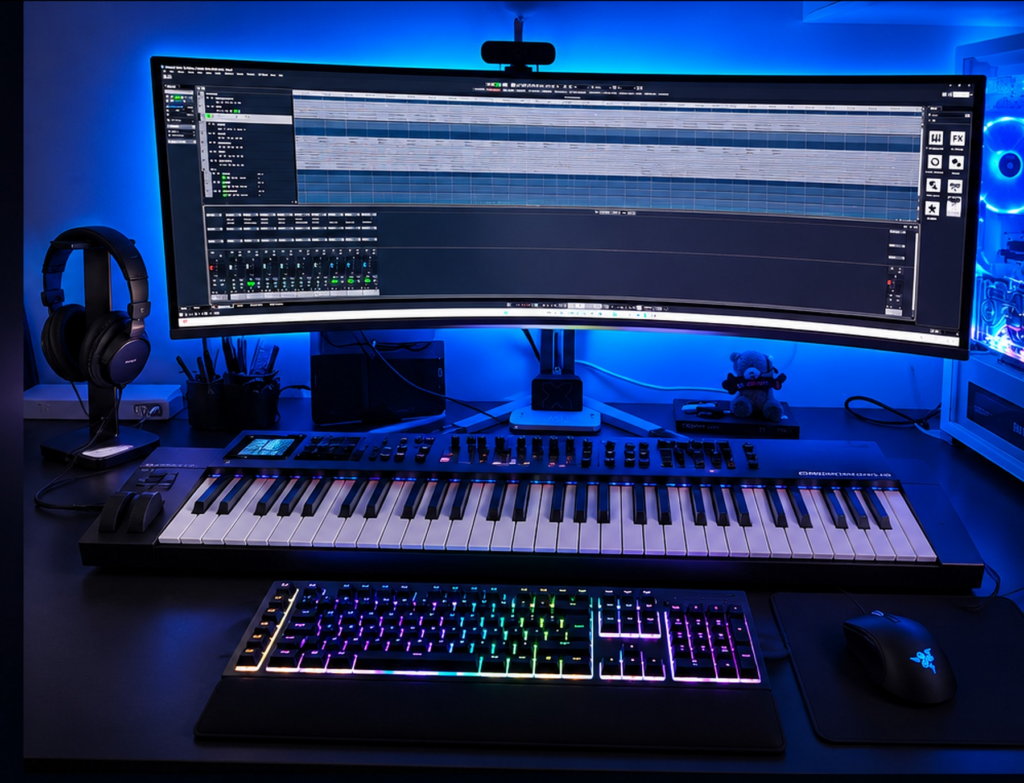
Music (Aastralis Music) is one place where I notice the way my mind works. I enjoy writing lyrics and developing musical ideas. I can stay with a line or melody until it feels right. Mastering a song is a different matter. The technical detail and number of small decisions can overwhelm me. Sometimes my brain simply cannot manage that stage.
I can enjoy and do well at one part of making music, then struggle with another. The same is true at work. Autism does not give me a uniform set of strengths. It shapes how I approach things, and the effect depends on the task and the environment.
People often associate autism with logical thinking, attention to detail and intense concentration. Some autistic people describe these as strengths, and research has recorded strengths reported by autistic workers (Cope and Remington, 2022). Reviews also caution against assuming that every autistic person shares these traits or that they point to one particular career (Griffiths et al., 2024).
Do you need to be autistic to work in AI?

No. AI needs people with many different skills and backgrounds. It involves research and engineering, but also product design, data quality, infrastructure, security, governance, communications and knowledge of the sectors where AI is used. A diagnosis should never become an informal job requirement, and autistic people should not be channelled into technical roles because of assumptions about how they think.
The research directly connecting autistic people with AI work is still limited. A letter in the journal Autism asks whether AI will create opportunities or add to barriers autistic people already face in employment. Early research with autistic software engineers looks at their experiences, strengths and work preferences. Another study explores how autistic workers use large language models for workplace communication, including concerns about the quality of advice an AI tool may give. Research into visual data annotation considers whether this work might offer an employment pathway connected to AI development.
A recent Fortune article has brought this debate into the boardroom. Palantir CEO Alex Karp, who is dyslexic, argues that neurodivergent people could be well placed as AI changes work. He is talking about neurodivergence broadly, including autism, ADHD and dyslexia. The article also includes autistic psychologist Daniel Wendler, who sees value in different perspectives but warns against describing every neurodivergent person as having a special “superpower.” That kind of stereotype can leave out people whose strengths are less visible and can hide the real challenges they face.
That balance matters to me. Different ways of thinking can add value, but a diagnosis is not proof of a particular talent. Employers need to recognise the individual, give people a fair chance to show what they can do, and provide support that fits their needs.
AI can support people, with care

My Master’s dissertation explored how AI might help with autism diagnosis and therapy. I was interested in whether technology could help people get useful support sooner and make that support more personal.
There is now a growing body of research on AI for autism screening, assessment and therapy. Reviews describe promising approaches, while also pointing to weaknesses in study quality, validation and representation (Reilly et al., 2025; Akemoğlu et al., 2026). These systems should support clinicians and autistic people as they make decisions. They should not be treated as a diagnosis by themselves.
AI tools may also help with everyday work, for example by making written communication clearer, organising information or breaking a complicated assignment into smaller steps. Wendler raises some of these possibilities in the Fortune article. The tools need to be tested with the people who use them, and workers should be able to decide whether they help. If a system assumes that everyone communicates in the same way, it can misunderstand autistic people and repeat familiar workplace problems. AI should be designed with autistic people involved from the start, and people should be able to question its suggestions.
The workplace matters

Tools alone will not make a workplace inclusive. Clear instructions, predictable processes, written communication and attention to sensory needs can all help people do their jobs. Research based on autistic workers’ accounts describes barriers around recruitment, workplace communication, sensory demands and whether a role fits the person (Southey et al., 2024).
Employers should ask what helps each person do their work well. They should not rely on stereotypes about autistic “superpowers” or assume that one set of adjustments will work for everyone. The UK’s Buckland Review of Autism Employment and the Expert Academic Panel on Neurodiversity both point to the need for practical, individual support and more inclusive workplaces.
Neurodiversity and human evolution

I believe neurodiversity may be part of human evolution. Different ways of noticing and solving problems may have helped human groups adapt. Researchers are examining evolutionary explanations for autism, including how certain traits may have contributed to different roles in human societies (Hunt and Jaeggi, 2025). This remains an area of debate, not a settled account of why autism exists.
Evolution does not make every trait useful in every situation, and some autistic people need substantial support. My belief is that human variation has value, while the experience of disability and difficulty also deserves to be taken seriously.
Making room for different minds

My diagnosis came after my studies and years after the start of my career. It helped me understand myself, but it did not decide what I could achieve. I write music and work in AI. I also struggle with some tasks, including mastering a song as well as sudden changes to my schedule.
I would like the AI industry to be a place where autistic people can contribute if they want to, and where they can get the support that works for them. That benefits the people who work in the field and the people who use the systems it creates. No one should need an autism diagnosis to belong in AI, and no one should be ruled out because they have one.
Having collated a lot of references from my Masters, I like to also keep reading articles and studies, below are some of those.
Further reading and sources
Autism, AI and employment
- Michal Waisman Nitzan, Liron Lamash, Darren Hedley, Simon M. Bury and Eynat Gal, “Letter to the editor: Employment of autistic individuals in the age of AI integration: Challenges and opportunities”, Autism (published online 2025; issue 2026). Directly considers the opportunities and risks AI creates for autistic employment.
- Marco Quiroz-Gutierrez, “Palantir’s Alex Karp says AI will let neurodivergent workers thrive. An autistic psychologist says he has a point”, Fortune (25 October 2026). Reports Karp’s view alongside Daniel Wendler’s support for different perspectives and caution about “superpower” stereotypes.
- JiWoong Jang, Sanika Moharana, Patrick Carrington and Andrew Begel, “It’s the only thing I can trust”: Envisioning Large Language Model Use by Autistic Workers for Communication Assistance, CHI 2024. A study with 11 autistic participants exploring LLMs as workplace communication support, including risks in the advice such systems give.
- Madalena Sasportes, Grischa Liebel and Miguel Goulão, “Investigating the Experience of Autistic Individuals in Software Engineering”, arXiv preprint (2025). Interviews and survey responses about autistic software engineers’ strengths, work preferences and experiences; early research, not yet a broad workforce study.
- Orvila Sarker, Mona Jamshaid and M. Ali Babar, “Inclusive Employment Pathways: Career Success Factors for Autistic Individuals in Software Engineering”, arXiv preprint (2025). A systematic review of 30 studies on education, employment preparation, workplace conditions and support tools.
- Daniel Laister et al., “Empowering Neurodiversity: Analyzing the Potential of Visual Data Annotation as Employment for Autistic Individuals”, preprint (2025). Participatory research exploring visual data annotation as a possible employment pathway.
- Ginu George, Mugdha Kulkarni and Bindi Varghese, “AI in creating inclusive work environments for neurodiverse employees”, Advances in Autism (online 2025; issue 2026). Discusses AI as a potential tool for more inclusive workplaces; this is a developing field and the claims should be read alongside empirical work.
- Abayomi Olusunle, “How neurodivergent minds could humanize AI governance” (World Economic Forum, 2025). A perspective on representation in AI design and governance; useful as commentary rather than empirical evidence.
- Microsoft Customer Stories, “EY helps enhance the inclusivity of AI development with Azure AI” (2024). A case study of EY neurodivergent technologists contributing to the accessibility of AI tools.
- EY, “Gen AI for accessibility: More human, not less” (2024). Report on how disabled and neurodivergent employees use generative AI at work, including first-person accounts.
- OECD, “AI to Support Neurodivergent Learners in Vocational Education and Training” (2026). Looks at AI and other technologies in vocational learning, work-based learning and transition to work.
- Wall Street Journal, “People With Autism Are Hot Hires for AI Jobs” (2019). Early reporting on employers hiring autistic people for work connected to AI.
- Wall Street Journal, “Jobs for the Autistic Grow Beyond Tech” (2024). Reporting on autism employment programmes and the spread of inclusive hiring beyond technology.
- Auticon, “Top AI/ML Roles for Autistic Professionals” (2024). An industry perspective on AI and autistic talent; useful as an example of current discussion, rather than independent proof of aptitude.
- UK Department for Work and Pensions, Expert Academic Panel on Neurodiversity: Final Report and Recommendations (2026). Recommends needs-led employment support and universal design, with research to address evidence gaps.
- EY, Global Neuroinclusion at Work Study 2025. A company survey reporting AI use among neurodivergent professionals; read as industry survey evidence, not an independent clinical or academic study.
Strengths, barriers and working conditions
- Rosie Cope and Anna Remington, “The Strengths and Abilities of Autistic People in the Workplace”, Autism in Adulthood (2022). Survey research on strengths reported by autistic adults, including focus, creativity, memory, efficiency and dedication; the authors also discuss limitations in who the study could reach.
- Sarah Southey, Rae Morris, David Nicholas and Megan Pilatzke, “Autistic Perspectives on Employment: A Scoping Review”, Journal of Occupational Rehabilitation (2024). Synthesises autistic people’s perspectives on access, communication, role fit, sensory needs and mental health at work.
- David Thorpe et al., “The Lived Experience of Autistic Adults in Employment: A Systematic Search and Synthesis” (2025). Review centring autistic workers’ accounts and the role of workplace environments and acceptance.
- Benjamin Wen et al., “Autism and neurodiversity in the workplace: A scoping review of employer-focused research”, Journal of Vocational Rehabilitation (2024). Maps employer perspectives, interventions and gaps in the research.
- Michał T. Tomczak et al., “Autistic Employees’ Technology-Based Workplace Accommodation Preferences Survey: Preliminary Findings”, International Journal of Environmental Research and Public Health (2023). Examines workplace technology preferences and reported work challenges.
- Martin Weber et al., “Physical workplace adjustments to support neurodivergent workers: A systematic review”, Applied Psychology (2024). Reviews workplace adjustments, including noise and lighting, and finds the evidence promising but limited.
- UK Department for Work and Pensions, The Buckland Review of Autism Employment (2024). UK review of barriers and recommendations for improving autistic employment.
- Griffiths et al., “Understanding unique employability skill sets of autistic individuals: A systematic review”, Journal of Employment Counseling (2024). Reviews potential skills such as visual processing, detail, systemising and technology affinity, while cautioning that assumed links to specific occupations are not established.
- Emily Yarrow et al., “Interventions targeting work-related skills in adults with autism spectrum disorders: A comprehensive literature review”, Journal of Disability Policy Studies (2024). Reviews strategies to support employment skills for autistic adults.
- Disability, Autism @ Work Playbook. Practical guidance based on research into Autism at Work programmes at Microsoft, SAP, JPMorgan Chase and EY.
AI for autism diagnosis and support
- Aoife Reilly et al., “The role of machine learning in autism spectrum disorder assessment and management”, Pediatric Research (2025). Reviews applications in screening, diagnosis, stratification and personalised support, alongside validation and trust gaps.
- “Implementation of generative AI for the assessment and treatment of autism spectrum disorders: a scoping review” (2025). Reviews early applications and highlights small samples, limited validation, bias and hallucination risks.
- “Artificial intelligence for tracking social behaviours and supporting an autism spectrum disorder diagnosis: systematic review and meta-analysis”, eBioMedicine (2025). Reviews AI analysis of social behaviours and calls for validation in diverse populations.
- Yusuf Akemoğlu, Emily Brooke Roberts and Jinjun Xiong, “A Systematic Review and Quality Appraisal of AI-Augmented Intervention Studies for Autistic Individuals”, Autism (2026). Finds promise in AI-supported interventions but says the evidence base needs stronger research.
- Julia Kuca et al., “Artificial intelligence-supported therapeutic interventions for autism spectrum disorder: a systematic review”, Frontiers in Psychiatry (2026). Reviews AI-assisted therapy studies and identifies gaps in sample size, participant representation and clinical evidence.
- “Artificial intelligence support for diagnosis of neurodevelopmental disorders during childhood: an umbrella review” (2026). Reviews systematic reviews and notes that promising accuracy figures often sit alongside low methodological quality and insufficient external validation.
Evolution and neurodiversity
- Adam D. Hunt and Adrian V. Jaeggi, “The DCIDE framework: systematic investigation of evolutionary hypotheses, exemplified with autism”, Biological Reviews (2025). A systematic evaluation of evolutionary explanations for autism; it compares hypotheses and discusses the limits of inference.
- Annie Swanepoel, “Editorial Perspective: Evolutionary psychiatry as a scientific framework for neurodiversity: implications for ADHD and ASD in children and young people”, Journal of Child Psychology and Psychiatry (2026). An editorial arguing that evolutionary psychiatry may offer a framework for understanding neurodiversity, while the broader debate remains active.