
What Is It Actually Like to Live Next Door to a Data Centre?
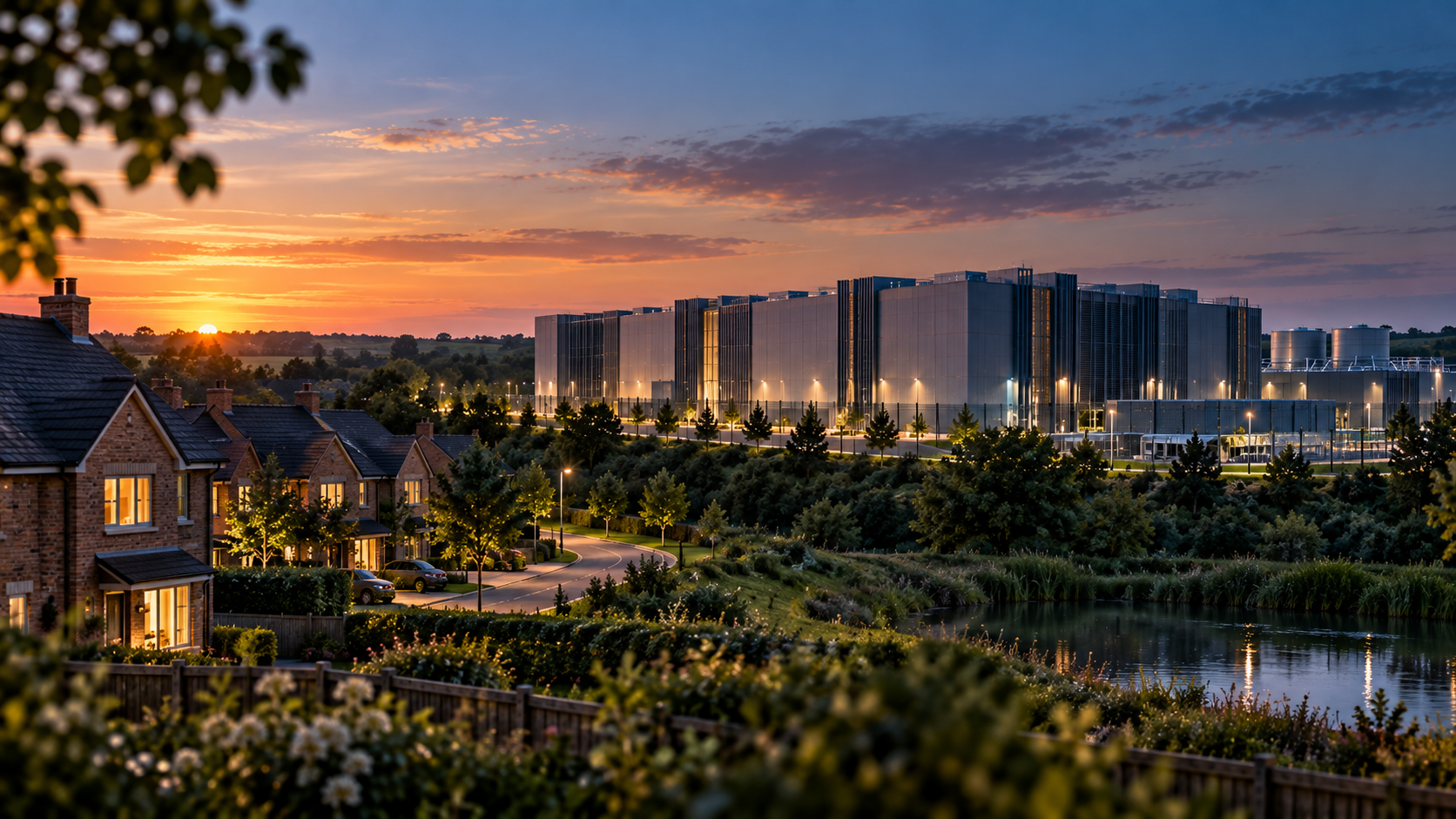
Let me start with a confession: I don’t live next door to a data centre.
I do, however, spend a significant amount of my working life around the technology that goes inside them, designing and thinking about AI infrastructure, power, cooling, GPUs and the increasingly difficult problem of operating extremely dense compute environments efficiently.
If you follow some of the public debate around data centres, though, living next door to one sounds fairly terrifying. There will apparently be a constant industrial hum, thousands of workers will descend on the area, the electricity grid will struggle to cope, huge quantities of drinking water will disappear into cooling systems, rows of diesel generators will pump pollution into the surrounding community and, to top it all off, the value of your house will collapse.
Then there is the increasingly familiar acronym: NIMBY: Not In My Back Yard.
It’s an expression that is often used rather dismissively. Somebody might agree that we need more renewable energy, electricity transmission, housing, railways, data centres or other infrastructure, just not when somebody proposes building it near them.
But I think simply labelling people as NIMBYs misses an important point. If somebody proposed building a large industrial-looking facility near my home, I’d want to know what impact it would have too. How noisy will it be? Will there be more traffic? What happens to the electricity network? Does it consume huge quantities of water? What are those generators for? And yes, will it affect the value of my home?
Those are perfectly reasonable questions.
The problem starts when reasonable questions are answered with assumptions rather than facts.
So let’s imagine what it might actually be like to live next door to a modern data centre.
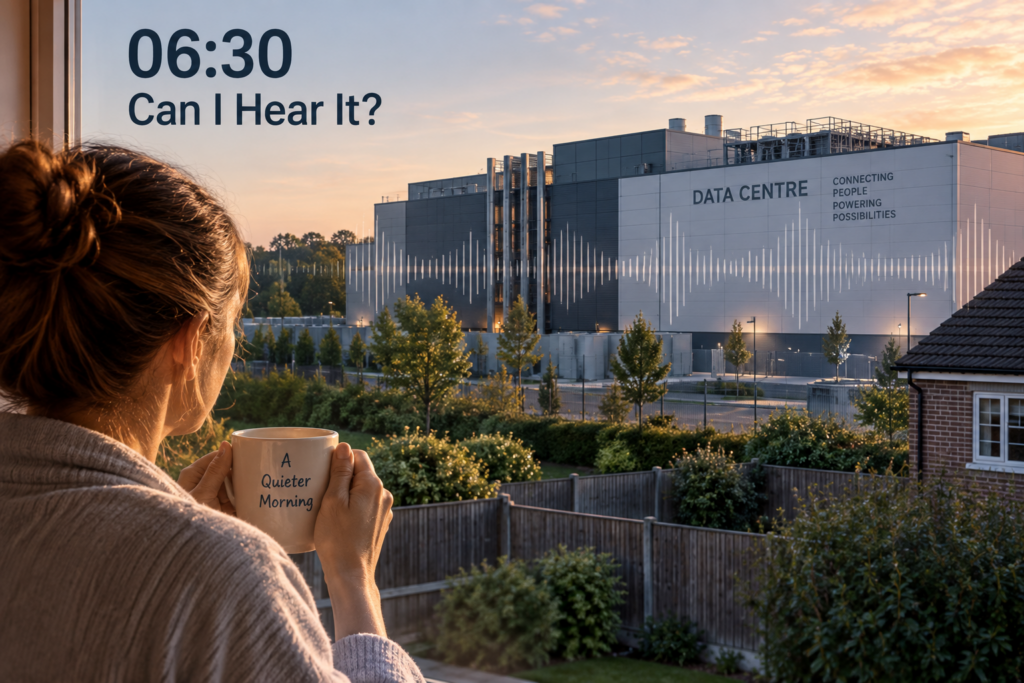
Noise is probably one of the first concerns I’d have. Data centres contain a lot of equipment that makes noise. Thousands of server fans move air, pumps circulate coolant, transformers hum and cooling equipment operates outside the building. Depending on the design, there may also be chillers, cooling towers, dry coolers and other mechanical plant.
So claiming that data centres don’t make noise would clearly be nonsense. The much more useful question is how much of that noise actually reaches the people outside the site.
Those are two very different things.
Much of the noisy equipment inside a modern data centre is enclosed within the building. External mechanical equipment can be positioned, screened and acoustically treated specifically to reduce its impact beyond the site boundary. Modern facilities can also be designed around acoustic modelling before they’re built rather than waiting for somebody living nearby to complain afterwards.
That doesn’t mean noise concerns should be dismissed. Poorly designed facilities can create problems, particularly with persistent tonal or low-frequency noise. Generator testing, cooling equipment and badly positioned mechanical plant can absolutely become irritating to neighbouring communities.
But those are engineering and planning problems rather than an unavoidable consequence of computing. A well-designed data centre should be engineered so that the extraordinary amount of activity happening inside becomes remarkably uninteresting outside.

Except they don’t.
This is another strange perception around data centres. When somebody announces a billion-pound infrastructure project, it’s natural to imagine a huge industrial complex employing thousands of people and creating a daily flood of traffic.
During construction, there certainly can be substantial activity. Groundworks, steelwork, electrical infrastructure, cooling systems, networking, security and eventually the IT equipment itself all have to be installed. There will be contractors, deliveries, cranes, heavy vehicles and periods of considerable construction activity.
But construction and operation are very different things.
Once operational, a data centre doesn’t require thousands of people walking through the doors every morning. Modern facilities are heavily automated and typically operate with comparatively small teams responsible for engineering, security, networking, facilities and maintenance.
Ironically, this is sometimes used as an argument against data centres. Critics point to the scale of investment and ask why it doesn’t create thousands of permanent jobs.
That’s a legitimate economic question, but we can’t simultaneously argue that data centres will overwhelm communities with thousands of workers and complain that they don’t employ enough people. Both cannot be the defining problem.
There is another important difference compared with many traditional industrial sites. A data centre isn’t constantly receiving raw materials and shipping finished physical products. Once the infrastructure is operational, the main thing moving in and out of the building is data.

This may be the biggest misconception of all.
A large AI data centre can require tens or even hundreds of megawatts of electrical capacity. Those numbers are enormous, and for somebody living nearby the obvious conclusion might be that all of that electricity is being taken away from homes and businesses in the surrounding area.
But a 100 MW data centre isn’t connected to the electricity network using an enormous extension lead plugged into the same circuit as the neighbouring houses.
Power infrastructure is one of the fundamental constraints determining whether a large data centre can be built in the first place. Large facilities require substantial electrical infrastructure, potentially including high-voltage grid connections, substations, transformers, switchgear and reinforcement of the surrounding transmission or distribution network.
The capacity has to exist, or additional infrastructure has to be created to provide it.
But perhaps we also need to challenge another assumption: does every data centre have to be built in the same places and powered in the same way?
Increasingly, I don’t think it does.
The traditional model has often been to build large data centres where there is already significant grid connectivity and network infrastructure. But AI infrastructure gives us an opportunity to think differently about location, particularly for workloads that don’t have to sit within a few milliseconds of a major city.
Imagine, for example, a smaller AI data centre built in a rural location, appropriately separated from residential properties and close to where energy is actually being produced.
That energy might come from solar, wind or another local renewable source. It might also come from something less frequently discussed in the data-centre conversation: anaerobic digestion.
Agricultural waste, manure, food waste and other organic materials can be processed through anaerobic digestion to produce biogas, which can then be used to generate electricity. Instead of viewing the data centre purely as another enormous consumer attached to an already constrained electricity grid, you can begin to think about placing compute alongside generation.
Now the conversation becomes much more interesting.
A rural data centre could potentially consume locally generated renewable energy, while the heat rejected by its cooling system could become useful to another nearby activity. Perhaps that heat supports greenhouses, agricultural buildings or, as we’ll come to later, even helps keep livestock warm.
That doesn’t mean every farm should suddenly have an AI data centre next to the barn, nor does it mean anaerobic digestion alone can power the enormous hyperscale campuses being discussed today. There are questions of scale, reliability, economics, connectivity, grid balancing and backup power that still have to be solved.
But it illustrates a much bigger point.
Location and energy strategy should be considered together.
Rather than continually asking where we can find another 100 MW of grid capacity for a data centre, perhaps sometimes we should ask where energy is available, or could be generated, and whether suitable compute can be taken to it.
For certain AI workloads, that distinction could become increasingly important.
Training, batch inference and other workloads aren’t necessarily subject to exactly the same latency requirements as traditional cloud applications serving millions of interactive users. If the workload can tolerate being located further from a major population centre, then the design possibilities become considerably wider.
And from the perspective of the person supposedly “living next door”, there’s another obvious advantage.
Perhaps hardly anybody needs to.
Put appropriate infrastructure in an appropriate rural or industrial location, design the acoustics properly, screen it sympathetically and think about power generation and heat reuse from the beginning, and many of the objections discussed in this article become very different conversations.
That doesn’t mean the wider electricity debate disappears. Who pays for network reinforcement? How should limited grid capacity be allocated? How quickly can additional generation and transmission infrastructure be built? How do we ensure that data-centre growth doesn’t compete unnecessarily with housing, transport and conventional industry for constrained electrical capacity?
Those remain serious infrastructure and energy-policy questions.
But they’re very different from the idea that a data centre simply arrives, plugs itself into the local electricity network and causes the lights in the neighbouring houses to flicker.
If we’re going to debate the electricity requirements of AI, let’s debate the real problem and let’s also be prepared to rethink where the compute should go.
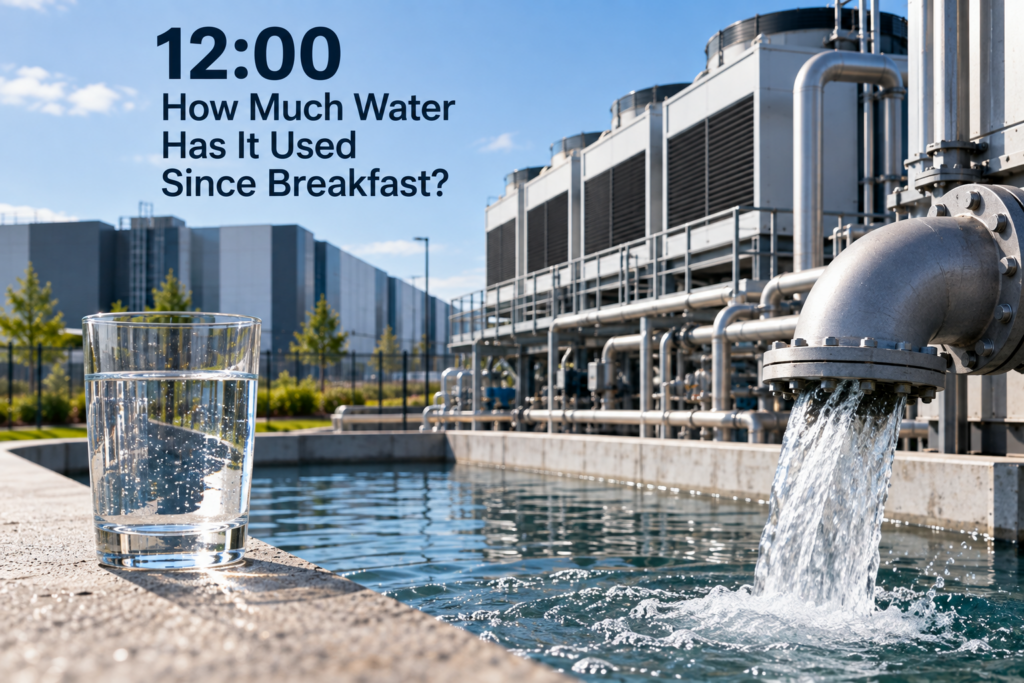
I’ve written about this one before because the idea that every data centre consumes enormous quantities of drinking water has become one of the industry’s most persistent myths.
Like many good myths, it contains just enough truth to make it believable.
Some data centres absolutely do consume significant quantities of water. The mistake is assuming that every cooling system works in the same way.
Evaporative cooling, closed-loop liquid systems, direct-to-chip cooling, chillers and dry coolers have very different characteristics. Increasing rack densities from AI are also forcing us to rethink data-centre cooling because a conventional server rack and a modern high-density GPU rack present completely different thermal engineering challenges.
Liquid cooling is consequently becoming increasingly important, particularly direct-to-chip designs where heat can be removed much closer to the components generating it.
But liquid cooling does not automatically mean consuming enormous quantities of water.
A closed cooling loop circulates coolant through a system. The fact that the word “water” appears somewhere on an engineering diagram doesn’t mean fresh drinking water is continuously being poured into one end and disappearing from the other.
That’s the distinction I explored in my previous article about the data-centre water myth: water usage and water consumption aren’t necessarily the same thing.
Rather than asking whether data centres use water, we should be asking what cooling architecture a particular facility uses, where its water comes from and how much water it actually consumes.
The answer can be dramatically different from one data centre to another.
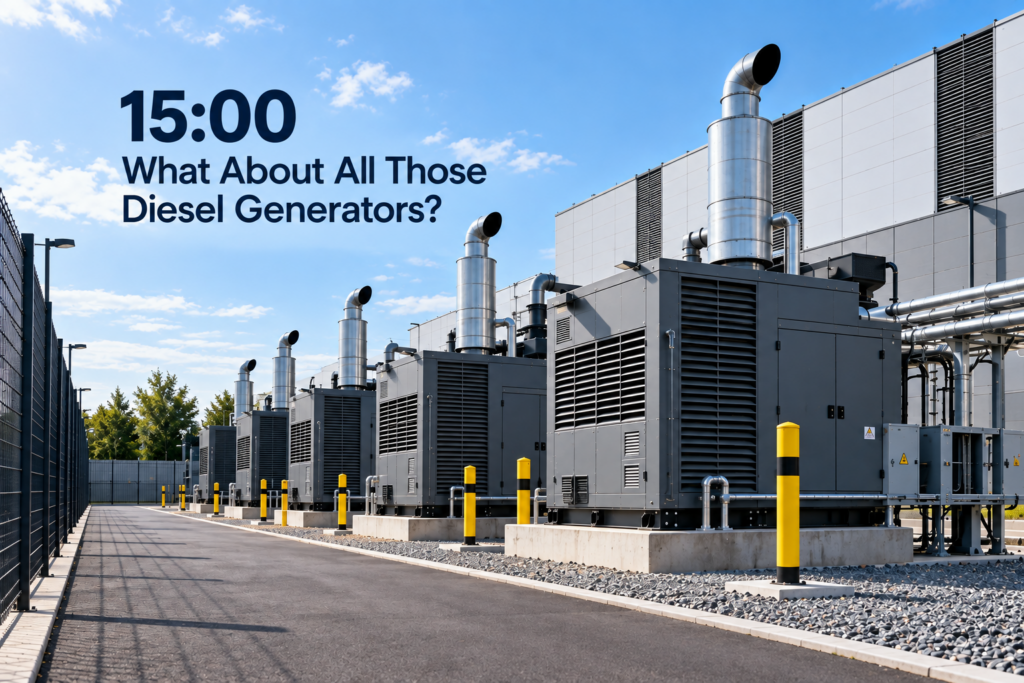
You’ve probably seen photographs of large data centres surrounded by generators. There can be a lot of them, and understandably that leads people to assume they’re part of the normal power supply for the facility.
They aren’t.
Backup generators exist because data centres are designed around resilience. If grid power disappears, thousands of customer workloads can’t simply be told to wait patiently until somebody fixes the problem.
Data centres therefore have multiple layers of electrical protection and redundancy, and generators provide one of those layers. Under normal operating conditions they spend most of their lives doing remarkably little.
They do, however, have to be tested, and this is where there is a legitimate conversation to have. Generator testing can create both noise and emissions. During an actual prolonged electricity failure, generators may also operate for significantly longer periods.
Those impacts shouldn’t be hidden or dismissed, particularly when a facility is located close to residential areas. But emergency backup infrastructure shouldn’t be confused with the normal source of electricity for the building.
Seeing twenty generators outside a data centre doesn’t mean twenty diesel engines are sitting there running 24 hours a day to power ChatGPT, Netflix and your cloud storage.
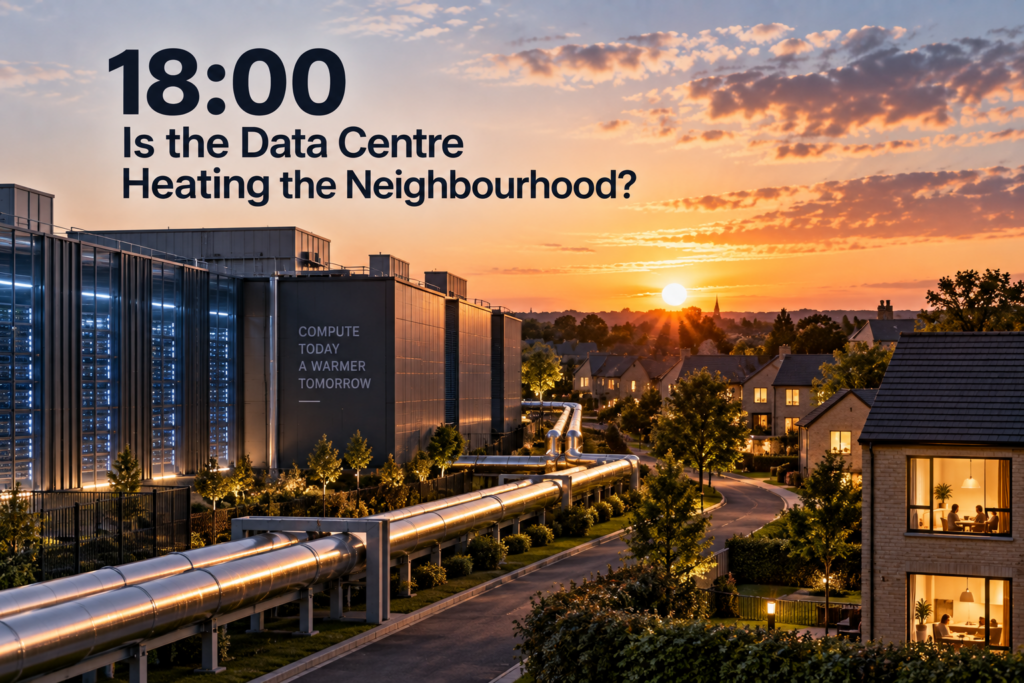
Data centres produce enormous quantities of heat. Fundamentally, almost all the electrical energy consumed by computing equipment eventually becomes heat, so putting megawatts of computing equipment inside a building inevitably means dealing with megawatts of thermal energy.
That’s why cooling is such an important part of data-centre engineering. But cooling systems exist specifically to capture that heat and move it away from the equipment. The interesting question is increasingly whether we should continue treating all of that thermal energy purely as waste.
If a facility is removing enormous quantities of heat every hour of every day, perhaps the better question is whether somebody nearby could use it.
District heating networks are the obvious example, but we don’t have to think only about heating thousands of homes. Commercial buildings, leisure centres, greenhouses and industrial processes can all potentially make use of recovered heat.
And remember that rural data centre we imagined earlier, perhaps using locally generated renewable energy or electricity produced from anaerobic digestion?
This is where the idea becomes even more interesting.
If agricultural waste from a farm can help produce energy for compute, why couldn’t some of the heat produced by that compute find its way back into the agricultural operation?
Imagine the farmer is already paying to keep livestock buildings warm during colder months. Could recovered heat from the data centre help keep the pigs warm instead?
It sounds slightly amusing, but it’s actually a good illustration of joined-up infrastructure. Agricultural waste contributes towards producing energy. The data centre turns that energy into computation. The heat created by that computation is captured and reused by the agricultural operation.
Waste becomes energy. Energy becomes compute. Compute produces heat. And the heat becomes useful again.
That’s a far more interesting model than simply drawing electricity from one side of a facility and throwing heat away from the other.
It doesn’t mean every data centre is going to become a giant central-heating system for the surrounding countryside. The temperature of the recovered heat, distance between producer and consumer, infrastructure costs, seasonal demand and economics all matter.
But it demonstrates why location matters so much.
Instead of designing the data centre in isolation and then asking what to do with its environmental impact afterwards, perhaps we should increasingly design the energy source, data centre and surrounding users of energy as one system.
Instead of only asking, “How are you going to get rid of all that heat?”, perhaps we should also ask, “Who nearby could use it?”
If the answer happens to be a few thousand very comfortable pigs, that’s still a considerably better outcome than simply throwing the energy away.

Fair enough.
This is one criticism of data centres that the industry shouldn’t try to explain away with technology. They’re big buildings, and some of them aren’t particularly attractive.
A badly designed industrial building dropped next to a residential community can have a genuine visual impact. Landscaping matters. Building height matters. Lighting matters. Screening matters. The position of cooling and electrical equipment matters, and above all, location matters.
This is where the NIMBY label can become particularly unhelpful.
If somebody objects to a poorly screened industrial building being constructed at the end of their garden, dismissing them as a NIMBY doesn’t answer their concern. The responsibility should also be on developers to demonstrate that they’re building something appropriate for the location.
Data centres need to be good neighbours. That means understanding the community they’re joining rather than assuming the economic importance of digital infrastructure automatically overrides every local concern.
And there is another question that will inevitably be asked.

This one matters because for most people their home is the largest financial asset they’ll ever own.
If somebody announces plans for a large data centre nearby, it’s completely understandable that residents might worry that their property values are about to fall. You’ll sometimes hear the assumption stated almost as fact: nobody will want to live next to a data centre, therefore house prices will collapse.
But that skips over the question of why a nearby development would affect property values in the first place.
People don’t normally object to a building because it contains servers. They object to the things they expect to experience because that building is there: noise, traffic, visual impact, pollution, lighting or some other form of disturbance.
Which brings us straight back to everything else in this article.
If the data centre produces little perceptible noise at the site boundary, doesn’t generate large amounts of operational traffic, doesn’t continuously run diesel generators, doesn’t create clouds of emissions, isn’t consuming the local drinking-water supply and is appropriately screened and landscaped, what exactly is the mechanism that automatically makes every neighbouring house worth less?
That doesn’t mean a data centre cannot affect property values.
Location matters enormously. A huge industrial building overlooking previously open countryside could affect how desirable some properties are. Poor landscaping, intrusive lighting, badly controlled noise or increased traffic could understandably influence what somebody is prepared to pay to live nearby.
But that’s very different from saying:
Data centre nearby = house prices fall.
Property markets are influenced by a huge range of factors, and the characteristics of the individual development matter.
There’s also an interesting comparison we rarely make.
Imagine two identical houses.
One overlooks a busy distribution warehouse with hundreds of vehicle movements every day, including HGVs arriving and departing throughout the night.
The other overlooks a well-screened data centre where most of the activity takes place inside a secure building and relatively few people or vehicles come and go once construction is finished.
Which one would you rather live beside?
I’m not suggesting the answer will always be the data centre. I’m suggesting that the label “data centre” tells you remarkably little about what it will actually be like to live next to it.
Rather than simply asking whether a data centre will reduce property prices, ask what characteristics of the proposed development could affect the surrounding community and what the developer is doing about them.
Noise, traffic, lighting, landscaping, building height, visual screening, construction and power infrastructure are tangible things that can be measured, modelled, designed and, importantly, improved.
Fear that a mysterious building full of computers will automatically wipe thousands of pounds off the value of every house nearby is something rather different.

Probably not. Data centres are designed to operate continuously.
But 24-hour operation doesn’t have to mean 24-hour disturbance.
There aren’t raw materials being delivered every few minutes. There aren’t finished products leaving on articulated lorries throughout the night. There isn’t necessarily a huge night shift arriving at 10pm, and there isn’t a manufacturing process involving furnaces, stamping machines or production lines operating behind the walls.
Inside the building, thousands of processors may be performing trillions of calculations. Huge quantities of data may be moving through fibre connections, and increasingly those processors may be training or running the AI systems that millions of people use.
Outside the building, ideally, almost nothing interesting is happening.
And that brings us to something that gets lost surprisingly often in the debate about data centres.
A Data Centre Isn’t One Thing
Perhaps the biggest myth is treating every data centre as though it were identical.
They’re not.
A 15-year-old hyperscale facility using evaporative cooling isn’t the same thing as a modern AI facility using direct-to-chip liquid cooling and dry coolers. A 10 MW regional facility isn’t the same thing as a 500 MW campus, and a data centre built beside a residential development isn’t the same proposition as one built on a large industrial site.
Cooling architecture differs. Power architecture differs. Compute density differs. Water consumption differs. Noise characteristics differ. Even the type of work being performed inside the building differs.
Yet we frequently take a statistic from one facility, in one country, using one cooling technology, operating under one set of environmental conditions and apply it to the entire global data-centre industry.
That’s how myths become accepted as facts.
It’s exactly what has happened with water, and increasingly I think we’re seeing the same thing happen with electricity, noise and environmental impact.
NIMBY Isn’t Necessarily a Dirty Word
As the UK and other countries attempt to build the infrastructure required for AI, the NIMBY debate is going to become increasingly important. We’re going to need more data centres, but we’re also going to need more electricity generation, more substations, more transmission infrastructure and significant changes to the way energy is generated and distributed.
Someone is going to live near some of it.
But that doesn’t mean we should automatically build every new data centre close to large population centres and then complain when the people living there object. Perhaps part of solving the NIMBY problem is simply better infrastructure planning.
Some data centres need to be close to cities because latency, connectivity and customer requirements dictate their location. Others don’t. Some workloads could potentially be placed much closer to renewable generation, rural energy projects or locations where both land and electricity are more readily available.
That’s particularly interesting for AI.
Instead of always transporting enormous quantities of electricity to the compute, there will be situations where it makes more sense to take the compute to the energy. A rural facility powered partly by local renewables or anaerobic digestion, positioned away from dense housing and designed so that its waste heat can support neighbouring agricultural or commercial activities, presents a very different planning proposition from a huge anonymous grey building dropped beside a housing estate.
Neither model is automatically right or wrong. The point is that data centre location should reflect what the facility actually needs to do.
It’s easy when discussing national infrastructure strategy to draw a line on a map and say, “Build it there.” It’s rather different when “there” happens to be outside somebody’s kitchen window.
So I don’t think the answer is to ridicule people who ask questions about infrastructure being built near their homes. The answer is to give them better information, and sometimes to ask whether we’re proposing to build the infrastructure in the right place in the first place.
Ask about the noise specification. Ask about the cooling design. Ask about water consumption. Ask where the electricity is coming from. Ask how often the generators will be tested. Ask about construction traffic, landscaping and lighting. Ask about the potential impact on property values.
But also ask two questions that I think will become increasingly important:
Why does the data centre need to be here?
And why is it being powered this way?
Those might ultimately be more important than many of the myths we’ve spent so much time debating.
So, What Is It Actually Like to Live Next Door to a Data Centre?
The interesting thing about living next door to a well-designed data centre is that, most of the time, very little should happen.
There aren’t articulated lorries arriving every ten minutes carrying raw materials. There isn’t a thousand-person night shift changing over. There aren’t chimneys continuously burning fuel to manufacture a physical product. And, despite what some headlines might suggest, somebody isn’t standing outside continuously pouring drinking water into the cooling system.
What is happening inside, however, is extraordinary. Thousands of CPUs and GPUs can be consuming megawatts of electricity, processing enormous quantities of data and increasingly providing the compute behind services used by millions of people.
AI makes that infrastructure even more important.
We are effectively building a new class of industrial infrastructure. Instead of manufacturing physical products, we’re increasingly manufacturing computation. And perhaps that gives us an opportunity to think differently about where the next generation of that infrastructure should live.
Not every data centre needs to be an enormous grey building on the edge of a town. Some compute will need to remain close to population centres, networks and users. But other workloads may be able to move closer to where energy is available, whether that’s wind, solar, anaerobic digestion or other forms of generation.
In the right location, we can potentially begin connecting things that have traditionally been designed separately: energy generation, compute, cooling and heat reuse.
Agricultural waste could contribute towards generating electricity. That electricity could power AI infrastructure. The resulting computation produces heat. And that heat might then support a greenhouse, heat an agricultural building or keep livestock warm.
That’s not a perfect circular system, and we shouldn’t pretend it is. But it’s the kind of joined-up thinking we should be exploring as demand for AI infrastructure grows.
So if somebody wants to build a data centre next door to you, ask the difficult questions. Being concerned about what is built in your community doesn’t automatically make you an unreasonable NIMBY.
Ask whether you’ll hear it. Ask what traffic it will create. Ask how much water it actually consumes. Ask what those generators are for. Ask whether it could affect your property. Ask what happens to all the heat it produces.
But perhaps most importantly, ask why it needs to be built there and where its energy will come from. Maybe some of the heat could warm local homes. Maybe it could heat a leisure centre. Maybe it could support a greenhouse. Or maybe it could just keep a few thousand pigs warm on a cold British winter’s night.
The point is that we should be discussing what the infrastructure actually does, where it makes sense to put it and how intelligently we can integrate it with the infrastructure already around it. Challenge the development where it deserves to be challenged. Challenge the developer to build it properly and to be a good neighbour.
But challenge the myths too.
Because sometimes the best way to make a data centre a good neighbour might be to make sure it has very few neighbours in the first place. And outside the fence, a properly designed data centre should still be rather boring.
Perhaps that’s exactly the point.